Starting a Family is Riskier For Women With IDD

Starting a Family is Riskier For Women With IDD

Starting a Family is Riskier for Women with IDD

Exceptional Parent Magazine, April 2022

Starting a Family

BY CRAIG ESCUDÉ, MD, FAAFP

Most people with intellectual and developmental disabilities (IDD) want what everyone else does—the opportunity to live life to its fullest. For some, this includes having a family. For anyone, the decision to start a family is usually a big one. However, people with IDD, their families, and supporters have additional factors to consider. They are at greater risk for poor pregnancy outcomes.

We know that there are health disparities in many areas relating to people with IDD. There are lower rates of health screening for diseases like diabetes, prostate cancer and breast cancer. People with IDD are more likely to have chronic health conditions, to have undetected poor vision, and to have limited access to quality healthcare and health promotion programs, according to the Center for Disease Control (CDC).

Women with IDD are less likely to have cervical and breast cancer screenings and less likely to have ever visited a gynecologist. Studies have also shown that women with IDD have increased risk of pregnancy complications and adverse outcomes, including gestational hypertension and gestational diabetes. They are also shown to have a higher rate of caesarean delivery compared to women without IDD. Other noted increased risks include early labor, pre-term birth, and preeclampsia, which is a serious and potentially deadly condition associated with pregnancy.

IMPROVING THE SITUATION

Enough about the negatives. How do we make this better? Having access to quality healthcare is a good place to start. There are a number of factors that come into play when working to create a healthcare environment where everyone can receive quality care. Things like having a physical environment that facilitates access for people with mobility limitations, the availability of transportation to and from healthcare visits, and financial considerations all play a role. But, for this discussion, I’d like to focus on the healthcare provider-patient interaction.

THE ROLE OF THE CLINICIAN

A clinician should have the knowledge and training to provide healthcare for any given condition which they are responsible for treating. However, it is widely known that many, if not most, clinical training programs provide little IDD-specific healthcare training for their students. Besides improving clinical competency, education can help to reduce inaccurate stereotypes and preconceived notions about people. The CDC notes that there are stereotypes that exist in the healthcare world with assumptions being made that the quality of life of a person with IDD is poor or that they are unhealthy solely based on their disability or level of impairment. There is also stigma associated with having a disability that shapes attitudes and expectations and can also shape outcomes. These assumptions and stigmas are certainly not limited to the healthcare world. They permeate throughout society.

BETTER TRAINING LEADS TO BETTER OUTCOMES

There is no doubt in my mind that if you came to see me to have cataract surgery, you would have a very poor outcome. Why? Because I am a family physician, not a trained ophthalmologist. As a family physician and knowing my lack of training in this procedure, I would refer you to someone who has expertise in the field. This makes perfect sense, right? But for people with IDD, especially adults, clinicians with training and experience in providing healthcare for people with IDD are few and far between. Don’t get me wrong, there are indeed clinicians and clinics that do a wonderful job of providing healthcare for people with IDD, however, sometimes people have to drive hours to get to them. In some communities, when word gets out that a particular clinician does a great job providing healthcare to people with IDD, they get overloaded with patients who are desperate to find good healthcare. We must do better as a healthcare profession to ensure access to quality healthcare for all.

IDENTIFYING THE ISSUES

One of the ways to make thing better is to study in more detail exactly what the problems are that contribute to the issues. The Administration for Community Living’s National Institute on Disability, Independent Living, and Rehabilitation Research division has just awarded a three-year grant to the Lurie Institute for Disability Policy at Brandeis University to support research toward advancing pregnancy experiences for women with disabilities. The goals are to address gaps in knowledge about pregnancy and disability, to develop interventions to support and enhance the pregnancy experience, and to ensure optimal pregnancy related outcomes. This is certainly good news! One of the ways that they plan to ensure optimal outcomes is through active dissemination of findings and trainings for stakeholders. Training is the key.

THE PROVIDER-PATIENT RELATIONSHIP IS A TWO-WAY STREET

There is a great responsibility on the part of health professional training programs to educate clinicians on providing healthcare to people with IDD. There is also a great opportunity for people with IDD to foster the growth of clinically competent and compassionate clinicians. What I am about to say may certainly add to the frustration of people with IDD and their supporters in terms of not being able to find clinicians to meet their needs, but if we view it as an opportunity, we can make it a win-win situation.

I’ve heard from countless people with disabilities, their supporters and nurses about the frustration they experience when looking for good healthcare. I’ve also heard from many that they should not have to train clinicians. They want clinicians that are already trained in this area. First, let me say that I could not agree more. But, the reality is that this is not the world in which we currently live. But, sharing the resources above can help make it so.

I believe that anyone, with or without a disability, should be able to present to any clinician’s office, emergency room or hospital and receive a basic level of competent and compassionate healthcare. Improving clinician education and fostering better clinician-patient communication will certainly work to make this ideal a reality.

ABOUT THE AUTHOR:

Craig Escudé, MD, FAAFP is a board-certified Fellow of the American Academy of Family Physicians and the American Academy of Developmental Medicine and is the President of IntellectAbility ( replacingrisk.com). He served as medical director of Hudspeth Regional Center in Mississippi and is the founder of DETECT, the Developmental Evaluation, Training and Educational Consultative Team of Mississippi. He has more than 20 years of clinical experience providing medical care for people with IDD and complex medical conditions and is the author of “Clinical Pearls in IDD Healthcare” and the “Curriculum in IDD Healthcare.”

HELPING CLINICIANS UNDERSTAND: WHAT ROLE CAN FAMILIES AND SUPPORTERS PLAY?

There is an opportunity here. An opportunity to work with clinicians to help them improve their skillset and provide better care. What role can families and supporters play?

  • Know that most healthcare providers want to provide good healthcare. Starting with this understanding may help alleviate the thoughts that clinicians just do not care.
  • Help clinicians to see the person with IDD as a person, first: someone with interests, likes, hobbies, friends, and activities. This helps clinicians understand that their patient is a person like everyone else, with a quality of life that can be improved with good healthcare, and that helping them resolve or better manage their clinical issues can help them resume their normal life activities.
  • Increase the awareness of clinicians’ knowledge about organizations and resources that can help them gain knowledge in the field of IDD healthcare. Here’s a few of them:
    • The American Academy of Developmental Medicine and Dentistry: AADMD.org
    • The Developmental Disabilities Nurses Association: DDNA.org
    • The book, Clinical Pearls in IDD Healthcare: replacin- grisk.com/product/clinical-pearls
    • The eLearn Course, “Curriculum in IDD Healthcare:” https://replacingrisk.com/academy/idd-training-curriculum
  • Be as prepared as possible for healthcare appointments, having up-to-date health information readily available along with concise medical history, medications and social information as well. Utilizing a Health Passport document can be very helpful. Here’s an example of one: r eplacingrisk.com/down-loadables/HRST-Health-Passport-Fillable-PDF.pdf
  • Advocate for incorporation of formal training about IDD healthcare into medical, dental, nursing and allied health professional schools in your area. This training can include using the Curriculum in IDD Healthcare. Use the influence you may have through advocacy organizations and with legislators to help ensure that future clinicians can meet the needs of everyone.


Feature originally published by Exceptional Parent Magazine.

Caretaker organizations facing ‘epic shortage’ of direct service providers

Caretaker organizations facing 'epic shortage' of direct service providers

Caretaker Organizations Facing ‘Epic Shortage’ of Direct Service Providers

The Washington Times, September 2021

Caretaker-organizations-facing

Ernestine Bryant cares for adults with disabilities, and she recently received her first pay raise in five years: She now makes $9.50 an hour, up from $9 an hour.

A direct service provider in Tifton, Georgia, Ms. Bryant is living paycheck to paycheck and considering leaving the field for a higher-paying job.

“I love what I do and I don’t want to leave, but I’ve also got to live,” she said.

As an employee of Diversified Enterprises, Ms. Bryant has remained a direct service provider (DSP) longer than many others. She is laboring in a field with a high turnover rate and a shortage of workers.

An estimated 8.2 million more direct care workers will be needed through 2028 because of turnover and job growth projections, said Joseph Macbeth, president and CEO of the National Alliance for Direct Support Professionals Inc.

“The question should be ‘Where are they going to come from, and how are we going to keep them?’” Mr. Macbeth said.

About 1.4 million Americans work as DSPs, aiding people with intellectual and developmental disabilities. Mr. Macbeth said the industry has an average annual turnover rate of about 43%, meaning 600,000 professionals leave their jobs each year, based on data from the National Core Indicators Staff Stability Survey.

The cost of replacing a DSP ranges from $2,413 to $5,200, totaling more than $2 billion each year, he said.

Dr. Craig Escudé, president of IntellectAbility, which provides resources and training to agencies that support people with disabilities, said the pandemic has increased the turnover rate. Some workers or their relatives have become ill, causing DSPs to leave their jobs.

“There’s also a lot of fear in this field as well because, if staffing is short and, let’s say, you are working in a home and it comes to the end of your shift and there’s no one else to fill that shift, you may be asked or required to stay there longer. So, you might be having to work a double shift or even a triple shift,” Dr. Escudé said.

Many states have reported being so short-staffed that some DSPs are bringing clients to emergency rooms because they cannot provide services and care for them, he said.

Half of U.S. states have reported permanent closures of Medicaid home and community-based service providers since the COVID-19 pandemic began, Disability Scoop said Friday in a report citing the Kaiser Family Foundation.

The survey, which included responses from service providers in 41 states through mid-July, found that 25 states reported at least one provider that had permanently shuttered its doors.

Direct service providers’ low wages factor into decisions about leaving the field.

Median hourly wages for DSPs providing in-home support range from $11.50 to $11.90, said Mr. Macbeth, citing data from the National Core Indicators Staff Stability Survey. DSPs providing nonresidential support receive a median hourly pay of $12.50.

Diane Wilush, president and CEO of United Cerebral Palsy of Georgia and United Cerebral Palsy of South Carolina, said her organizations are facing an “epic shortage” of DSPs.

“It’s never been this bad,” she said, noting an annual turnover rate of 50%.

The organizations have budgeted to have two DSP staff members for every four people in a group home, but Ms. Wilush said they can staff only one DSP at most places.

“We don’t have the people,” she said. “It’s a very complex job that has always been undervalued.”

The DSP shortage affects people who receive in-home care, support in residential settings and help with daytime activities, Ms. Wilush said.

More than 472,900 people were on states’ waiting lists for home and community-based services, according to the Case for Inclusion 2020 report, a collection of data and policy recommendations about Medicaid programs for people with disabilities.

United Cerebral Palsy of South Carolina can have a workforce of 165 but currently has 24 DSP vacancies, Ms. Wilush said. The Georgia counterpart can have a workforce of about 455 but has 94 DSP positions open.

“It’s a crisis that is growing every day,” Ms. Wilush said. “It’s an incredible situation that we can’t figure out the answer to.”

Two UCP homes in South Carolina are competing with manufacturers in the hunt for employees. Ms. Wilush said UCP can’t offer manufacturing wages and is considering closing the two homes for lack of staff.

DSP turnover rates ranged from 24.4% in the District of Columbia to 68.8% in Nebraska, according to the Case for Inclusion 2020 report.

Because of the chronic turnover, Ms. Wilush said, DSP organizations cannot provide the highest quality of care and services. She said it takes time for clients to build relationships with their caretakers and for DSPs to get a good sense of those in their care.

Ms. Bryant, the direct service provider in Georgia, said she has known her clients for at least a couple of years and has grown close to them. She said she would consider staying to work as a DSP if the job paid more.

“Nine, 10 dollars, 11 dollars an hour for the job that we do — I don’t think that’s good enough because it’s not an easy job,” she said. “You’re caring for someone, especially for some individuals where you have got to do everything for them.”

“You love doing a job and you have gotten so involved in that program with the individuals that you support, and they’re just like a family to you. And they have known you for so many years, and all of a sudden you have to leave because the pay is not good enough for the hard work that you do,” Ms. Bryant said. “And then they’ve got to hire someone else to replace anybody that’s leaving, and they’ve got to start all over again.”


Feature originally published by The Washington Times.

Quality Care to Those With IDD Scarce

Quality Care to Those With IDD Scarce

Quality Care to Those with IDD Scarce

ABLE, May 2021

Recently published data showed how almost 60 percent of physicians feel they cannot provide quality care to people who live with intellectual or developmental disabilities (IDD). In fact, a new survey reveals details on nurses’ difficult experiences with physicians in working to get appropriate healthcare for the people with IDD they support.

The study published in EC Nursing and Healthcare in February can be an emotionally difficult read. “Learning about current attitudes and perceptions about people with IDD that many physicians have is heartbreaking.,” said. Craig Escudé, physician and president of Intellect Ability. “It’s commonly known by family members, nurses, direct support professionals and people with disabilities that finding a clinician who understands the unique needs of people with disabilities is challenging.

The experiences of the nurses related in this survey explains why.” Some of the quotes provided by these nurses include: “During a consultation with an ER physician, the doctor stated that people like my patient aren’t meant to live that long and have no quality of life;” “Physician uncomfortable with treating individuals with IDD. Appeared either scared or annoyed;” and “I’ve had a number of physicians, instead of treating our individuals, recommend hospice because of a poor quality of life.” These comments further emphasize the need to improve how medical schools educate their students about the fundamentals of providing healthcare for people with disabilities.

“It’s more than just learning about how to treat medical conditions commonly seen in people with IDD like aspiration pneumonia and bowel obstruction,” said Escudé, who conducted the nursing survey, “Physicians should be taught about the support structure for people with IDD, how to facilitate better communication and, most importantly, about the often-missed direct relationship of various adverse behaviors to treatable, underlying medical causes.” A survey of 714 practicing physicians revealed that only about 40 percent of physicians were greatly confident about their ability to provide the same quality of care to patients with a disability and 56 percent strongly agreed that they welcomed people with a disability into their practices.

The study published in February also related that 82 percent of physicians believed that people with a significant disability have a worse quality of life than those without a disability. Several studies have shown that people with IDD have a greater likelihood of getting COVID-19 and of dying from COVID. The most recent study notes that people with an intellectual disability have a 5.9 times greater risk of dying from COVID the second, only to age, as the greatest risk factor.

The most recently developed program to train clinicians is the Curriculum in IDD Healthcare. It’s a six-module, online course that teaches the fundamentals of IDD healthcare FOR medical students and practicing clinicians, “Online learning programs make it easy to learn from experts in various fields without having to hire new school teaching staff or attending live lectures,” Escudé said. “When we educate clinicians, we save lives,” says Escudé. “The efforts being made to improve IDD healthcare education, while overdue, will undoubtedly have a tremendously positive impact on the lives of millions of people with intellectual and developmental disabilities in the US.”


Feature originally published by Able.

Putting People Before Their Disabilities In The Workplace

Putting People Before Their Disabilities In The Workplace

Putting People Before their Disabilities in the Workplace

HR.com, July 2021

Putting People

How to facilitate outstanding working relationships between those with and without disabilities

The term “Intellectual and Developmental Disabilities” also known as “IDD” refers to disabilities associated with intellectual function and/or physical and developmental differences. Diagnosis requires evidence of limitations in both intellectual abilities and in adaptive skills such as managing day-to-day life activities like food preparation, getting dressed, handling money and other related activities. Some people with IDD have difficulty relating their thoughts verbally which can create a communication barrier between those with and those without disabilities.

They may, instead of using words, use gestures or express themselves through actions or behaviors. These behaviors may not be recognized by some as a form of communication and maybe dismissed or even seen as disruptive. Gaining an understanding of how to communicate with people with various levels of disability can facilitate improved working relationships as well as better satisfaction in the workplace.

Respectful communication is important in any job or relationship. When working with people with disabilities, we must remember that they are people, first, and speak in that manner. For instance, in the second sentence of this paragraph, I used the term “people with disabilities” rather than “disabled people.” Putting the “person” first in language helps to put the person first in our minds, seeing them as a fellow co-worker with a few challenges rather the as the challenge itself. And let’s be honest, we all have challenges and need support, at times. This small but essential concept is central to fostering a respectful environment where everyone is valued.

People with disabilities want the same things that anyone else wants from a job; a sense of purpose, a feeling that their work matters, and the satisfaction of earning a wage. When a company incorporates people with disabilities into their workforce, they are fostering integration into community life and increasing the level of natural supports. This can replace the need for more significant paid support where staff is paid to help them with day-to-day life. Opportunities like these can improve peoples’ confidence, self-esteem, sense of belonging, and overall well-being.

Because many people with IDD have lived lives segregated from others, those without disabilities have often had little interaction with them throughout their daily lives. This can lead to challenges in their own communication skills in relating to those with disabilities. Training is important for all staff to learn about good communication and how to facilitate outstanding working relationships between those with and those without disabilities.

Learning about person-first language, person-centered thinking, understanding how different behaviors may be forms of communication, and about how a different quality of life doesn’t mean a lower quality of life can help to create a work environment that is productive for the employer and where all employees feel valued. And that’s a good thing!


Feature originally published by HR.com.

Good communication, better outcomes

Good communication, better outcomes

Good Communication, Better Outcomes

Physicians Practice, August 2021

Good communication better
By: Dr. Craig Escude

Why this is especially true for patients with intellectual and/or developmental disabilities.

The nature of communication between physicians and patients can greatly affect the overall outcome of a visit. When a patient’s desire or ability to communicate their symptoms to a clinician is hampered, the clinician may not have the needed information to make an accurate diagnosis. Conversely, when a clinicians’ skills in communicating with different types of patients is limited, crucial information may be missed. There is much talk about cultural competency in today’s world. Usually, you hear about the need for clinicians to be culturally competent relating to race, ethnicity, and gender variances. There’s another group where communication is often challenging but vital to good healthcare and outcome improvement. That group is comprised of an estimated 7.5 million people in the US with an intellectual and/or developmental disability (IDD).

One of the main reasons that challenges exist in treating patients with IDD is that most clinicians have received little, if any, training in medical schools and residency programs. I was one of them. It was very eye-opening to me when I started working at a residential program for people with IDD and realized I knew so little about how to meet their healthcare needs. One of the biggest misconceptions I had to overcome was that people with intellectual disabilities who also don’t use verbal language can still express and communicate a great deal of helpful clinical information, usually in the form of behaviors. However, what commonly occurs when we see a person with IDD exhibiting various behaviors is that we attribute them to the disability rather than recognizing that many behaviors are often pointing to underlying, treatable medical conditions. And it only takes a small amount of training to unlock these insights that can dramatically improve outcomes.

Here are a few insights and clinical pearls I learned about facilitating better healthcare interactions with people affected by IDD.

Trending: 13 Red Flags Your Pain Patient is a Drug Seeker

Respectful communication is important in any relationship.

When working with people with disabilities, we must remember that they are people first, and speak in that manner. For instance, in the second sentence of this paragraph, I used the term “people affected by IDD” rather than “disabled people.” Putting the “person” first in language helps to put the person first in our minds, seeing them as a human being with value who has a few challenges rather than as the challenge itself. Similarly, this helps emphasize that a different quality of life does not equal a lower quality of life—an essential concept to approaching people with IDD with compassion.


There are a number of behaviors that can point to specific underlying and treatable medical conditions that are frequently dismissed by supporters and clinicians.

One example is hand-mouth behavior where a person puts their hand in their mouth frequently or likes to chew on objects. It’s easy to say, “they do this just because they have a disability.” Were you aware that these behaviors are commonly seen in people who have underlying gastroesophageal reflux?


Sometimes aggressive behaviors, especially when they appear in certain contexts, can point to a treatable condition.

For instance, a person who becomes agitated around mealtimes or who spits out their food may have learned that every time they eat or chew, they will have pain from an undiagnosed dental condition. They then exhibit “disruptive behaviors” in their attempt to avoid discomfort. Unfortunately, what often happens is that a person with these symptoms is prescribed psychotropic medications to “calm them down” which only masks the real problem.


Feature originally published by Physicians Practice.

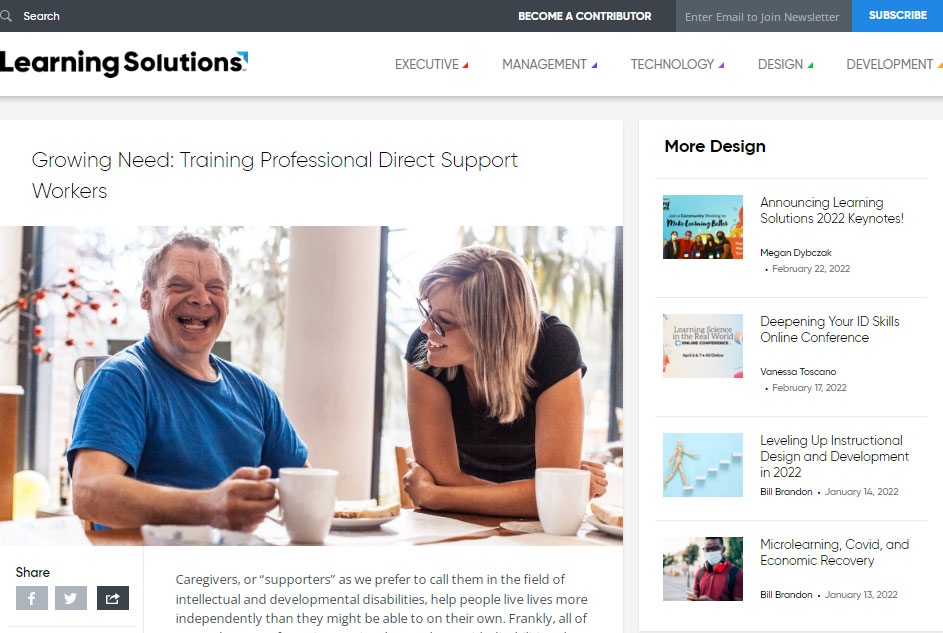
Growing Need: Training Professional Direct Support Workers

Growing Need: Training Professional Direct Support Workers

Growing Need: Training Professional Direct Support Workers

Learning Solutions, August 2021

Growing Need Training

Caregivers, or “supporters” as we prefer to call them in the field of intellectual and developmental disabilities, help people live lives more independently than they might be able to on their own. Frankly, all of us need support from time to time but
to those with disabilities, those who are aging, many with dementia, and others with conditions or circumstances that limit their self-support abilities, a supporter is a very important person in their life. And while it’s harder than ever to find
people to fill these roles, the demand is only growing. The Bureau of Labor Statistics projects that from 2019 to 2029, overall employment of home health and personal care aides is projected to grow 34%, much faster than the average for all occupations,
which they project at a 4% growth during the same time period.  

The need for direct support training: large and growing

One of the most important components of being a successful direct support professional (DSP), especially in the field of intellectual and developmental disabilities (IDD), is being appropriately trained to perform the job. In people with IDD, there are
often communication challenges that make it difficult for supporters to understand the needs of the person they are supporting. And, in people with IDD, behavior is often a form of communication. But, because many of us are not used to interacting
and working with people with disabilities, we often mistake behaviors as “just something they do because of their disability” or worse yet, as something that they should be medicated for to control without attempting to determine possible underlying
causes. For example, a person with a disability may be thought of as non-compliant or aggressive because whenever they are served food, they begin to appear agitated and throw their plate or spit out their food. Someone who is trained to recognize
patterns of behavior in this field would astutely note that these could be signs that the person is experiencing a painful dental condition. They become agitated around mealtimes because they know that it will hurt when they try to chew. A simple
dental evaluation might completely resolve the issue and reduce needless suffering, not to mention prevent the person from being placed on a medication to control this “disruptive” behavior. While my example here was about people with disabilities,
the same would apply to any person who might have difficulty communicating with words, be it ageing, aphasia from a stroke, dementia, or other such conditions.  

Meeting the need for educating direct support professionals

Educating supporters about different health conditions that are more common in people with intellectual disabilities—how to recognize them, and what to do when they are noted—has been challenging because there has been little focus placed on the roughly
7.5 million people in the US estimated to have an intellectual and/or developmental disability. Even healthcare providers, including nurses and physicians, have received little training in health professional schools about this important field of
healthcare.

Online training for direct support professionals In recent years, online training has flourished in a number of fields including the field of direct support for people with disabilities and other conditions which limit full independence.
In terms of educating direct support professionals in the field of IDD, the National Association of Direct Support Professionals (NADSP.org) is one organization where members have the ability to earn e-Badges that demonstrate their knowledge and skills
learned about different subjects. They also provide a certification process for direct support professionals, as well. In terms of specifically learning about health and wellness-related issues for DSPs and others who work with people with IDD, Intellect
Ability has developed a number of eLearning courses that teach fundamental principles to people who work in this high-demand field of support-giving. Their most widely used training is called “The Fatal Five.” This eLearning course covers several
of the most serious medical conditions that are more commonly seen in people with IDD and pose significant health risks. This group of conditions includes major but preventable causes of illness and death, such as aspiration, bowel obstruction, seizures,
dehydration, and sepsis. A number of states and provider agencies license these courses to teach supporters about the identification, prevention, and management of these conditions.

About Intellect Ability Intellect Ability’s roots began in 1992. Along with training courses, webinars, and materials, Intellect Ability, formerly Health Risk Screening, is the sole developer, producer, and distributor of the web-based
Health Risk Screening Tool. The HRST is the most widely used and validated health risk screening instrument of its kind for people with intellectual and developmental disabilities. Intellect Ability’s focus is on developing tools and training for
the person-centered support of vulnerable populations. Intellect Ability educates and empowers support teams, administrators, and clinicians with necessary and proven tools for early risk detection. With unrelenting focus, we work to fulfill our mission
of providing tools and training to those who support people with vulnerabilities, helping them replace risk with health and wellness. Visit us at ReplacingRisk.com.

Teaching points for online IDD course design For those who design health-related training for clinicians and support staff such as physicians, nurses, DSPs, and others, including information about the specific health needs of people
with disabilities can help introduce these concepts to wider audiences. If case studies about a particular health condition are part of your course, consider making one of your patients someone with, for instance, a moderate intellectual disability.
The case can still be about the main condition but there might be additional teaching points that can be included such as communications challenges, working with a person’s support staff, or understanding that a change in behavior might be an indication
of pain.  

Online instructional designers are part of the picture

Training is an important factor for being a success in any field. As the demand for direct support professionals and caregivers for those needing support grows, we must also grow the number of trained supporters to meet the need. It’s certainly possible
that many of us in our lifetimes will rely on someone else to support us or a loved one for daily needs. Wouldn’t we want someone who is appropriately trained to do so?


Feature originally published by Learning Solutions e-Magazine.

Disability Advocates: Increase Provider Support, HCBS Access

Disability Advocates: Increase Provider Support, HCBS Access


Disability Advocates: Increase Provider Support, HCBS Access


Inside Health Policy, March 2021


Disability Advocates Increase


 Advocates are pushing to advance health equity for people with intellectual and developmental disabilities through policies like COVID-19 vaccine prioritization, increased access to home- and community-based services and better coverage and delivery of care. Stakeholders say both policy changes and a mental shift in health care providers’ perceptions of people with IDD are needed. “In my mind, the first thing that we need to do, the biggest mindset change that we need to understand, [is] that people with disabilities are…


Feature originally published by Inside Health Policy.

How to Help Loved Ones with Intellectual Disabilities with “Behaviors”

How to Help Loved Ones with Intellectual Disabilities with “Behaviors”

How to Help Loved Ones with Intellectual Disabilities with “Behaviors”

Belo Cipriani , December 2020

Disability Advocates Increase

By Dr. Craig Escudé

If someone you know with intellectual disabilities has behaviors, they’re normal. Everyone has behaviors.

When I’m in pain, I might squint my eyes, grimace and curl up in a ball, or I might scream and yell out causing alarm and anxiety to those around me. If my head hurts, I can get grumpy and want to cover my head to block out light and my ears to block out sound, or maybe just move to a quiet room. The list goes on and on…

Behaviors as a Language

When we hear the term “behaviors” relating to people with intellectual and development disabilities (IDD), what is usually being referred to are adverse actions that cause some sort of harm to or disrupt the lives of the person with disabilities or others around them. What’s often missed is that these behaviors are rarely “just because someone has a disability and that’s just what they do.” With careful investigation and an understanding of the “language” of behaviors, a cause can often be found. And, even better, many of these causes do not need treatment with antipsychotic medications.

The less able we are to communicate with words, the more likely we are to communicate with gestures and actions. Have you ever found yourself using hand gestures when trying to communicate with someone from another country that doesn’t speak your language? Actions do sometimes speak louder than words. When you walk by someone and they have their head down, they’re holding their right cheek and have a grimace on their face, you may be on the right track assuming that they may be experiencing some sort of dental pain. Learning patterns of particular behaviors can often help pinpoint the cause of them.

Let’s talk about a few categories of fixable causes for adverse behaviors.

Environment

What do you do when you are hot, or cold? Do you remove your clothing? Would you “steal” someone’s blanket from them? You might ask first for the blanket, but what if you were not a person who communicates with words? What if you are in a room that’s really noisy and your head hurts? You’d likely want to move to a quieter place. But, how about if you could not move yourself or communicate to someone else what you are feeling? Might you yell and become agitated?

We should think about environmental causes of distress. Many of these can quickly be remedied and can make a difference in a person’s overall state of distress.

Sensory Issues

Some people have aversions to various sensations. One of mine is something cold touching my skin. When a person with cold hands touches me, it literally feels something like a shock that makes me recoil and even sometimes give an angry look and a gruff vocalization.

Could the feel of a particular clothing item be causing distress? Is there a repetitive sound that is exceedingly irritating to some and not to others? Could certain food textures feel repulsive to someone causing them to spit the food out? The answer to these is “yes.”

Look at what a person is experiencing in sight, sound, taste, touch, and smell when a particular challenging behavior presents itself.  It’s possible that you might identify a pattern that points to something that is easily avoidable.

Social

There are people we like being around and people we don’t. There may not be anything particularly “wrong” with that person at all. It’s just a preference. If we have no real choice about who is around us for hours at a time, we may express our preferences through agitation, resistance, self-abusive behavior or aggression toward others.

Learned Behavior

We should also consider the possibility that a person is doing something adverse because they learned that stopping that behavior will get them something desirable. “If you quiet down, I’ll give you a soda.” What is being taught here? I get noisy, then I quiet down, I get a soda.

Medical

As a physician, this is the area that causes me the most concern. To know that there are people who are in pain and are suffering with underlying health conditions that are not being diagnosed, or worse, inaccurately diagnosed as a psychiatric condition, is disturbing.  Clinicians simply MUST learn the language of behaviors and to see them as valid presenting symptoms of illness rather than just “something that people with disabilities do.”  There are a number of behaviors that can point to specific underlying health conditions that are too numerous to share here, but I want to give you a few examples:

  • Spitting out food may be caused by pain when someone chews due to a dental abscess
  • Becoming agitated and aggressive when heading towards the dining table may be a sign that a person experiences something painful before, during, or after eating such as reflux or aspiration
  • Constantly putting their hands in their pants could be a sign of a genitourinary issue like a urinary tract infection or a yeast infection
  • Screaming or resisting taking a bath could be a sign that something ‘bad” happens when their clothes come off such as abuse
  • Waking up in the middle of the night screaming could be a sign of gastro esophageal reflux
  • Becoming withdrawn, less alert, and less interactive could be a sign of constipation
  • Being “hard to reach” could be associated with seizures
  • Scratching and hitting one’s chest along with anxiousness could be a sign of chest pain

Learn More About Easily Treatable Behaviors

I’ve seen many people in my clinical career on psychotropic medications in an attempt to reduce some of these behaviors only to find later that there was an underlying, treatable cause. Imagine if you were experiencing painful acid reflux that caused agitation, could tell no one, and were then sedated so that you would no longer “act out.” You’d still have the painful reflux, you just might be too sleepy to try to let someone know through your behavior. We can do better than this! Educating families, supporters, and clinicians in the language of behavior of people with IDD can go a long way to relieving unnecessary suffering.

Take time to learn more about behavioral manifestations of underlying medical, environmental, social, and sensory conditions. Then, share what you learn with supporters of people with IDD and clinicians who treat them. It just might make a big difference in the quality of life of someone close to you who can speak for themselves.

Dr. Escudé is a board-certified fellow of the American Academy of Family Physicians and one of the few Fellows of the American Academy of Developmental Medicine. He is the president of Health Risk Screening, Inc. which specializes in risk identification and mitigation in people with IDD and other vulnerabilities. HRSTonline.com. He is the author of Clinical Pearls in IDD Healthcare and the Curriculum in IDD Healthcare, an online course for physicians, nurses and other clinicians that teaches the fundamentals of IDD healthcare.


Feature originally published by The Disability Tribune.

Refresher on potential reactions to vaccines from patients with IDDs

Refresher on potential reactions to vaccines from patients with IDDs

Refresher on Potential Reactions to Vaccines from Patients with IDDs

Canadian Healthcare Network, March 2021

Refresher on potential Reactions

DR. CRAIG ESCUDÉ

People with more significant levels of intellectual and developmental disabilities are less likely to use words. Bevahiours that could be perceived as ‘acting out’ may be the only sign that they are experiencing arm soreness, nausea, fatigue, body aches, chills or generalized discomfort due to a recent vaccination.


Feature originally published by The Medical Post.