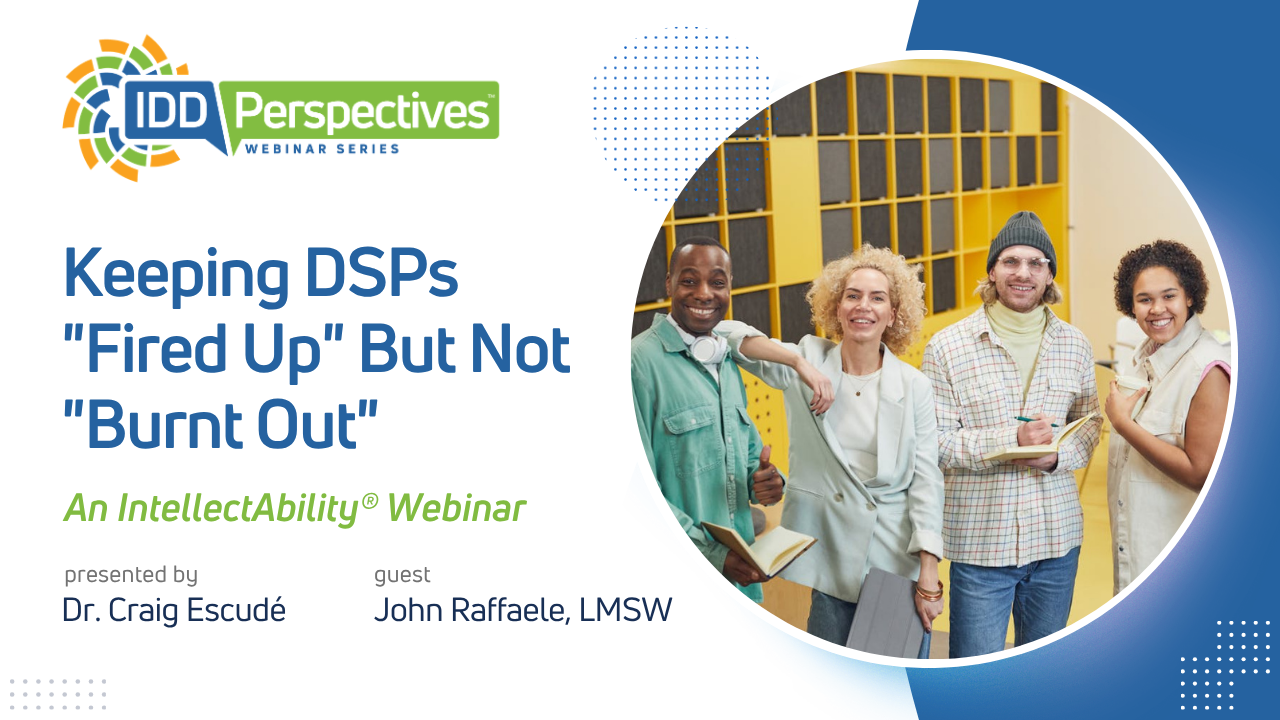
Keeping DSPs Fired Up But Not Burnt Out: What Every Provider Should Know
Direct Support Professionals (DSPs) are trained to do some of the most demanding, most undervalued work in the Intellectual and Developmental Disability (IDD) field. They show up every day for the people who need them, often for low pay, long hours, and little public recognition, yet their stability directly affects the health, safety, and health outcomes of people with IDD.
So, what actually keeps a DSP motivated? And what can organizations, families, and DSPs themselves do to prevent burnout before it happens?
That was the focus of a recent IDD Perspectives webinar featuring Dr. Craig Escudé, family physician and President of IntellectAbility, and special guest, John Raffaele, a nearly 40-year veteran of IDD services, education, and workforce development, who holds a Master of Social Work (MSW). John also serves as the Director of Educational Services at the National Alliance for Direct Support Professionals (NADSP).
This discussion examines what keeps DSPs motivated, what pushes them toward burnout, and what helps prevent it—from self-care and ethical practice to the role of supervision, team culture, and even new technologies such as AI.
What Actually Motivates a DSP?
Ask any DSP why they stay in the field — whether they’re brand new or 30 years in — and you’ll almost always get the same answer:
It’s the people.
That’s the number one reason DSPs keep doing this work, even when the pay is low and the hours are long: 90% say they enjoy making a difference in clients’ lives. But passion for the people they support isn’t enough on its own to prevent burnout. A few other factors matter just as much:
- Good supervisors — not just managers, but mentors, teachers, and coaches who improve the employee experience, and 84% of DSPs say appreciation from supervisors is key.
- A healthy team — most DSPs work in residential or day program settings alongside other staff, and a toxic team can drive even the most dedicated DSP to leave.
- Bringing your best self to work — easier said than done when DSPs may also be juggling caregiving of their own families at home.
Those meaningful connections can also give staff members a stronger sense of purpose and resilience.
Some organizations are taking this seriously by supporting DSPs’ lives outside of work, too — helping with things like childcare, or even offering staff reduced rates on retired fleet vehicles. Professional growth and opportunities for advancement also help DSPs see a future in the field and reduce turnover. It’s a reminder that supporting the workforce is just as important as supporting the people they serve.
Why The Work Matters More Than DSPs May Realize
It’s easy for DSPs to get buried in documentation and day-to-day tasks and lose sight of the impact they’re having. But that impact is real — and often lifesaving.
DSPs are frequently the first to notice that “something’s off” with the person they support; they often have strengthened their ability through person-centered relationships and knowing clients as individuals. For example, a change in bowel habits, a person holding their mouth strangely, or a shift in mood or behavior — this kind of pattern recognition, built on genuine relationships and familiarity, has led to emergency interventions that saved lives.
As Dr. Escudé put it, some of the most important diagnostic input he’s ever received as a physician started with a DSP saying, “He’s just not acting right.” Physicians who listen to that instinct — and take it seriously — get better outcomes for the people they treat. The Health Risk Screening Tool through IntellectAbility can help identify health risks for people with IDD and support earlier action. The result is improved consistency in care delivery, enhanced clinical oversight, and reduced exposure to preventable health complications and outcomes. The HRST is a validated health risk screening and stratification instrument designed for people with intellectual and developmental disabilities (IDD) and other at-risk populations. It enables organizations to identify, quantify, and proactively manage health risks that can lead to destabilization, adverse outcomes, avoidable suffering, and premature mortality. Learn more by visiting the Health Risk Screening Tool Overview.
The COVID-19 pandemic didn’t just validate how essential DSPs are — it also clarified that their role goes far beyond medical tasks, into emotional and psychological support. DSPs quarantined alongside the people they supported served as emotional lifelines during isolation, and helped communicate critical context to hospital staff when family and other visitors weren’t allowed in.
What Can DSPs Do to Protect Themselves from Burnout and Compassion Fatigue?
Self-care is one of the most underused tools DSPs have — largely because DSPs tend to be selfless people who put others first. That selflessness is part of what makes them so good at their job, but it also makes them vulnerable to overextending themselves. Some stress is normal in this work, but when it goes unmanaged, burnout or compassion fatigue can happen.
A few practical starting points:
- Actually take time off. Even something as simple as an afternoon off can matter — though this is often easier said than done. Adequate sleep, recovery time, and stepping back before physical exhaustion sets in all matter for reducing long-term health risk.
- Lean into what nourishes you. For many DSPs, that’s faith, spiritual practice, or community involvement.
- Move your body. Regular exercise doesn’t mean training for a marathon — a short walk on a break, or exercising alongside the person you support, can shift your mood and energy.
- Set boundaries between work and home. This is one of the hardest parts of the job. No individual habit matters more than leaning on supervisors and teammates to help you “hand off” emotionally at the end of a shift — especially if you’re on call on weekends or find yourself in the habit of taking work emotions home with you.
- Protect a workable routine. A predictable schedule and a more stable week can reduce fatigue and make it easier to recover between shifts.
Compassion fatigue can show up as irritability, reduced empathy, and increased absenteeism. It can also contribute to anxiety, depression, and other health issues.
Organizations play a role here too — by making self-care genuinely accessible, not just encouraged in theory. Effective strategies include access to mental health resources, regular recognition, and monitoring staffing and schedules to ensure predictable shifts and a stable week, reducing fatigue. When recovery and support do not happen consistently, burnout can interfere with a DSP’s ability to provide care.
What Role Does a Code of Ethics Play?
Just as physicians take the Hippocratic Oath, DSPs have their own guiding code: the NADSP Code of Ethics, first published in 2002 and recently revised for 2026.
The updated code is written directly to DSPs — using “I will” language — and centers on values like professionalism, accountability, and growth. It’s designed to act as a compass for the countless “oh no moments” DSPs face: situations they weren’t specifically trained for, where they still have to make an ethical, dignity-preserving choice in real time, while helping establish clear guidance and boundaries rooted in respect across the workplace. Leaders and supervisors should use the code to talk openly about what is expected, so staff know what they are responsible for.
While it’s written for DSPs, the code is a valuable resource for anyone who works with people with intellectual and developmental disabilities — including clinicians. Psychological safety and open communication also help teams apply the code consistently and stay engaged, and a supportive culture keeps Direct Support Professionals motivated.
Will AI Replace Direct Support Professionals?
Short answer: no.
AI can’t hold someone’s hand, offer a hug during a crisis, or build the kind of trust that comes from years of a relationship. What it can do is take some of the burden off tasks like documentation — a genuine pain point. Practical documentation systems and better tools can strengthen documentation skills, build confidence, and improve retention, especially for a new DSP still learning the role.
That said, both speakers were clear-eyed about the risks. AI-generated notes still require human review — DSPs remain accountable for anything they sign off on, AI tools can get details wrong, and supervisors need a clear plan for how staff should review and use them. Technology should support, not replace, the human judgment DSPs use in direct support services. Used carefully, technology can free up more time for the human connection that actually defines great direct support. Used carelessly, it can create new problems.
The Bottom Line
Direct support work is demanding, often thankless, and chronically undervalued as a profession — but it’s also work that changes, and sometimes saves, lives. Preventing burnout isn’t just an individual responsibility or self-care issue; it requires a long-range retention plan, supervisors who mentor, teams that support each other, organizations that invest in their workforce, fair compensation, and competitive pay, and understanding just how essential this work really is. Investing in professional development increases job satisfaction, providing opportunities for advancement reduces turnover, and helps staff see a bright and impactful future as a DSP.
Learn More