Avoiding Preventable Death in People with IDD Using the HRST: A Review of the Latest Mortality Research
For people with intellectual and developmental disabilities (IDD), health is never solely about lab values or medication lists. It is about whether someone can continue attending their day program, seeing friends, spending time with family, and doing what they enjoy.
It is also about whether the systems around them are capable of recognizing problems early enough to prevent avoidable crises and deaths.
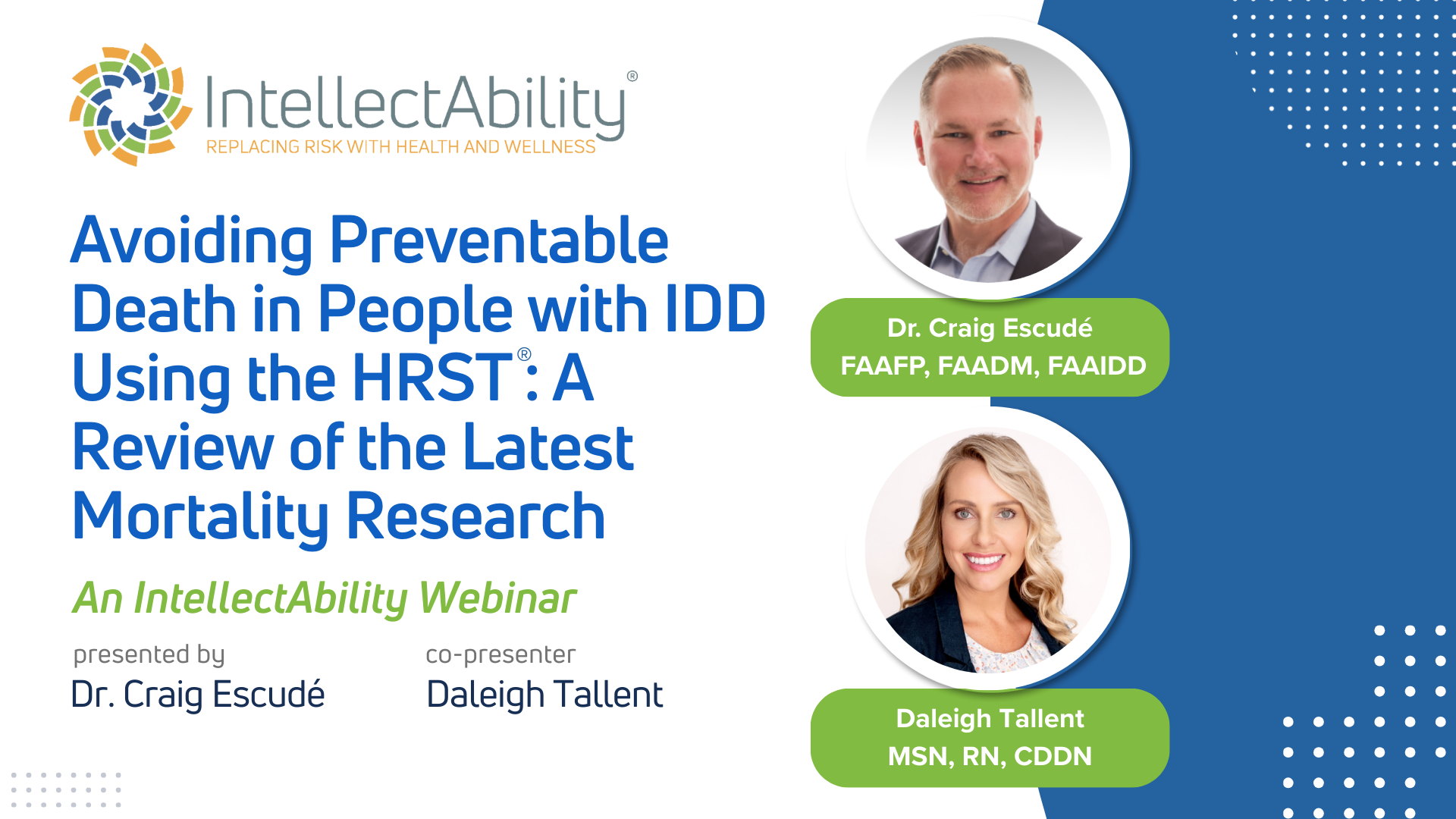
In the webinar Avoiding Preventable Death in People with IDD Using the Health Risk Screening Tool (HRST), Dr. Craig Escudé and IntellectAbility Clinical Director and nurse, Daleigh Tallent, reviewed powerful new findings from the 2023 Georgia Department of Behavioral Health and Developmental Disabilities (DBHDD) annual mortality report and showed how the Health Risk Screening Tool (HRST®) can help teams respond to those findings in concrete, person-centered ways.
This blog recaps the key messages from that session. It connects the mortality data to everyday practice, showing how the HRST can help reduce preventable deaths and improve quality of life for people with IDD.
Understanding Health Disparities for People with IDD
If you work in IDD services, you probably do not need to be convinced that health disparities exist. People with IDD visit emergency departments more often than people without disabilities. When they are hospitalized, they have a higher risk of dying. Research shows they are roughly twice as likely to die from preventable causes (The Center for Inclusive Health).
Many of these causes are related to what is often called the “Fatal Five”: aspiration, seizures, constipation and bowel obstruction, dehydration, and sepsis, along with severe complications of gastroesophageal reflux disease (GERD).
These outcomes are not inevitable. They reflect preventable differences in access, recognition, follow-up, and training.
Communication challenges are a significant factor. Many people with IDD cannot easily describe their pain, discomfort, or subtle changes in how they feel. Early signs of illness, such as a new change in behavior, a loss of interest in activities, small changes in appetite, or a slight shift in bowel patterns, can be overlooked or dismissed as “just how the person is.” Early detection and assessment of health concerns is critical to identifying health risks before they become serious problems for people with IDD.
On top of that, there is a widespread lack of training on IDD health for both clinicians and supporters. Most physicians receive little or no formal education about providing healthcare to people with IDD. Many case managers, direct support professionals, family supporters, and other supporters are not given the tools they need to recognize early warning signs of health destabilization. Add to this the reality of limited access to knowledgeable clinicians—especially in rural areas—and the constant pressure of budget constraints, and you have conditions that can easily amplify existing disparities.
Reduced access to appropriate support and resources further contributes to health disparities among people with IDD. Improving the availability and quality of healthcare services is a key modifiable factor in reducing preventable deaths and promoting health equity for this population.
What Dr. Escudé emphasized is that, even in the face of limited resources, we cannot allow people with IDD to decline simply because systems are complicated or funding is tight. We cannot ignore our responsibility to ensure that each person’s health is actively monitored, that risks are recognized, and that action is taken. That is where a structured, evidence-based tool like the HRST becomes essential.
What the Health Risk Screening Tool (HRST®) Does
The Health Risk Screening Tool (HRST) is a HIPAA-compliant, web-based screening tool developed to identify health risks in people with IDD and other at-risk populations, including people who are aging, people with physical disabilities, and people with traumatic brain injury. Rather than requiring new information, the HRST organizes and interprets data that teams are already collecting into a clear picture of health risks and necessary follow-up.
At its core, the HRST is a 22-item rating scale that examines several domains: functional status, behavior, clinical issues affecting daily life, physiological risk areas linked to the Fatal Five and other conditions, injuries and falls, and utilization of healthcare services, including hospitalizations and emergency room visits.
Each item is scored using straightforward yes/no questions and objective criteria. The tool does not allow users to simply “pick a number” based on a hunch. Instead, it calculates scores based on the answers entered and then assigns an overall Health Care Level from 1 through 6. These Health Care Levels categorize people based on their health risks to facilitate early detection and intervention. The HRST uses these categories as a classification scheme to group people according to their risk level, supporting targeted analysis and response.
Health Care Levels 1 and 2 are considered lower risk, Levels 3 and 4 represent moderate risk, and Levels 5 and 6 indicate higher risk. Once the rating is complete, the HRST generates a set of person-specific service considerations and training considerations. These are not generic suggestions. They are targeted recommendations that say, in effect, “Based on this person’s patterns of risk, here are the concrete steps the team should consider next,” and “Here are the topics supporters need training on to recognize and respond to these risks.”
Years of research, including peer-reviewed studies published in journals such as the Journal of Nursing Measurement, have shown that the HRST can predict mortality risk based on Health Care Level. That means the Health Care Level is not just an administrative category. It is a meaningful indicator of a person’s likelihood of death in the coming period, assuming no changes occur. This makes the HRST a powerful tool for prioritizing attention, shaping proactive interventions, and focusing limited resources where they are most needed.
By identifying health risks and guiding interventions, the HRST supports health promotion for people with intellectual and developmental disabilities.
Inside the 2023 Georgia DBHDD Mortality Report
The Georgia Department of Behavioral Health and Developmental Disabilities has produced an annual mortality report for adults with IDD for ten years. The 2023 report, which was highlighted in the webinar, examined a population of 13,916 adults with IDD who were at least 18 years old, had a primary diagnosis of an intellectual or developmental disability, and were Medicaid waiver recipients. Medicaid data was used to analyze mortality rates and health outcomes among this population, providing valuable insights into health disparities and trends.
Importantly, Georgia uses the HRST for people receiving both residential and non-residential supports. That reflects a critical belief: health risks do not disappear or suddenly change simply because someone lives in a different type of setting.
In calendar year 2023, there were 237 deaths in this population. That corresponds to a crude mortality rate of approximately 17 deaths per 1,000 people, or about 1.7 percent. Compared to US adults in the general population, adults with IDD experience higher mortality rates and unique health disparities. When the data were analyzed by HRST Health Care Level, a very clear pattern emerged. As the Health Care Level increased, the risk of death also increased. There was a marked jump at Health Care Level 4, which previous years of data have already associated with the highest risk of unexpected death.
When analysts looked back over a full decade of mortality reports, the same pattern held steady year after year. As the Health Care Level climbed from 1 through 6, mortality rates consistently rose. This stability over time supports the reliability of the HRST as a predictor of health risk and mortality, and it reinforces the importance of monitoring Health Care Levels and responding promptly when they change.
Key Findings: Risk Factors, Age, and Causes of Death
Daleigh Tallent highlighted several specific findings from the 2023 report that have direct implications for daily practice. One of the most important is that a two-point increase in Health Care Level is associated with a statistically significant increase in mortality risk. If a person’s Health Care Level jumps from, for example, 2 to 4, or from 3 to 5 within a year, that change should be treated as a serious warning sign. In reality, even a one-level increase should prompt a careful review, because it moves the person further along the continuum toward higher risk.
The report also identified certain individual HRST items that are strongly associated with mortality. Item V, which looks at hospital admissions within the past 12 months, is one of them. For each unit increase in the score for hospital admissions, the probability of mortality rises by roughly 36 percent. This connects directly with what Dr. Escudé shared earlier: when people with IDD are hospitalized, they carry a higher risk of dying in the hospital than the general population.
Item E, which captures clinical issues affecting daily life, is another important predictor. This item measures how often physical, mental, or behavioral health conditions prevent a person from engaging in their preferred activities. As the number of “affected days” goes up—days spent in the hospital, in healthcare appointments, or otherwise restricted by health issues—the score increases. For each score increase in Item E, the probability of mortality increases by about 29 percent. This suggests that when someone’s health increasingly interferes with their everyday routines, it should be interpreted as a sign of health instability that warrants active follow-up.
Age remains a factor, as it is in the general population. The study found that increasing age was significantly associated with mortality and that the highest risk of death was seen in the age groups 55 to 64 and 65 to 74.
However, the report also noted something unique about people with IDD: four of the leading causes of death in this group were not the same as those in the general population.
Conditions such as sepsis, pneumonia, and aspiration pneumonia appeared prominently. In many cases, death certificates did not specify whether pneumonia was community-acquired or aspiration-related, which likely means some aspiration pneumonia cases were hidden under a general pneumonia label. Sepsis and aspiration pneumonia are both Fatal Five conditions. Their prominence in the mortality data underscores the importance of training supporters to recognize early signs of infection, aspiration risk, and respiratory compromise.
Turning The HRST Data into Proactive Action
It is one thing to have data and another to know how to use it. The most powerful aspect of the HRST is not just the final Health Care Level number, but the way it directs teams toward specific actions and training priorities.
The first and most direct way to use HRST data is to take service considerations and training considerations seriously. For each person, the HRST generates specific recommendations based on their particular pattern of scores. These recommendations should not be seen as optional extras. They are designed to guide the work of the entire team: the person receiving services, family members, case managers, support coordinators, direct support professionals, nurses, day program staff, residential staff, and clinicians.
For example, consider someone who scores a 4 on the self-abuse item because they require one-to-one supervision due to self-injurious behaviors. The HRST might prompt the team to look for possible medical causes, especially if the behavior is new, worsening, or has been present for a long time without an underlying cause. Instead of accepting “this is just how they are,” the team is encouraged to ask, “What might be underneath this?” The related training consideration might direct the organization to train supporters on recognizing the signs of emergencies associated with self-injury and what to do in those situations. When teams actively use these service and training considerations as prompts for action, the HRST becomes a practical tool for prevention, not just documentation.
The second way to turn data into action is to pair HRST outputs with IntellectAbility’s clinical briefs. These short, focused documents help explain common risk areas in people with IDD and outline what clinicians should consider when evaluating them.
If a service consideration recommends ruling out medical causes for changes in behavior, a clinical brief on “medical causes of behaviors in people with IDD” can be shared with the primary care provider, neurologist, or psychiatrist. This brief provides context on communication differences, pain expression, sensory issues, and common underlying conditions, helping clinicians understand why a more thorough evaluation is necessary. In this way, HRST data can serve as a bridge between community-based supports and healthcare providers.
Integrating the HRST with Technology and Reporting
Modern support systems rely heavily on technology, and the HRST is designed to fit into that landscape. One example highlighted in the webinar is the interface between the HRST and StationMD, a telehealth service that focuses on people with IDD.
Through this partnership, StationMD clinicians can access a person’s HRST record during a telehealth visit. This gives them immediate insight into critical information such as whether the person uses a G-tube, has a known aspiration risk, or has a history of frequent seizures or hospitalizations. For the clinician, this context can shape vital decisions, such as the type of medication to prescribe and the form in which it should be administered.
The HRST can also connect with eMAR systems, like Impruvon Health, to import diagnoses and medications directly, reducing duplicate data entry and improving accuracy. In addition, IntellectAbility can work with organizations and states to connect the HRST to existing electronic systems, allowing key risk data to follow the person rather than being confined to a single platform.
Another powerful feature of the HRST is its reporting capabilities. The system includes more than 90 standard reports, as well as a flexible custom report builder. These reports can be used to identify patterns and inform decisions at the person, agency, or state level.
For example, a nurse or quality team can pull a report of everyone with seizure-related risk scores in the higher ranges and check whether seizure plans, monitoring, and staff training are in place and up to date. They can generate lists of people taking antiepileptic or psychotropic medications to ensure that monitoring for side effects, including tardive dyskinesia, is occurring as recommended. They can also build targeted reports focused on Fatal Five-related risk items, identifying who is most at risk for aspiration, constipation, dehydration, or sepsis.
Perhaps most importantly, reports can track changes in Health Care Levels over time.
If someone’s Health Care Level has increased by one or two points in the last year, that is a clear signal that their risk has grown and that the team needs to respond. Conversely, decreases in Health Care Level over time suggest that current supports and interventions are working and should be sustained and strengthened.
Tallent mentioned that she would want to run a report of everyone at Health Care Level 4, the level associated with the highest risk of unexpected death, to ensure that these people are receiving closer monitoring and proactive interventions. These are the people who may sound excited on Friday about weekend plans and then end up in a medical crisis before Monday if early warning signs go unrecognized.
Correcting Misjudged Risk: Insights from Ohio
In partnership with the Ohio Department of Developmental Disabilities, IntellectAbility conducted a pilot study in which supporters were asked to estimate a person’s Health Care Level before seeing the HRST results. Their estimates were then compared to the actual Health Care Levels generated by the tool.
The results showed that supporters often misjudged risk in both directions. In some cases, they overestimated the risk of people they believed to be more medically fragile than they truly were. In other cases, they underestimated the risk of people whose true Health Care Levels turned out to be higher than they expected. This matters because these judgments influence how support teams prioritize time, attention, and resources. When risk is underestimated, serious health issues may be overlooked or dismissed until they become emergencies.
In the same pilot, 79% of supporters agreed that the HRST identified risk factors they had previously been unaware of. These were real, actionable risk factors that simply had not been on their radar. The HRST not only uncovered those risks but also offered immediate, concrete guidance on the next steps through the service and training considerations. This finding reinforces the value of using an objective, evidence-based tool rather than relying solely on gut feeling or familiarity with the person.
Real-World Impact: What Happens When HRST is Used Well
The webinar concluded with real-world examples of systems and agencies that have achieved measurable results from intentionally and consistently using the HRST. Over time, organizations have reported reductions in unnecessary medications, decreases in average Health Care Levels, fewer falls, and fewer emergency department or urgent care visits.
Lower Health Care Levels are more than numbers on a dashboard—they represent added years of life and better daily experiences for the people being supported.
One example described a state that utilized HRST reports to identify patterns. They discovered a group of people who had similar behaviors, such as hand mouthing and pica, and many of them had service considerations recommending a gastroenterology consult to evaluate for GERD. The state followed those recommendations, arranged GI consultations, and found that many of those people did in fact have GERD.
After treatment began, their discomfort decreased, their hand mouthing and pica behaviors declined, and their agitation around mealtimes improved. With behaviors improving, teams were able to reduce or eliminate certain psychotropic medications, which in turn lowered the risk of side effects and polypharmacy.
For each of those people, the impact was deeply personal: less pain, more comfort, and a better quality of daily life. For providers and funders, these changes also meant fewer crises, fewer expensive medical interventions, and more efficient use of limited resources. The HRST served as the starting point that made those changes possible.
Moving Toward Prevention and Person-Centered Health
The ten years of mortality data from Georgia make one truth very clear: with the right tools, we can see risk coming. Higher Health Care Levels consistently predict higher mortality risk. Increases in Health Care Level, more frequent hospital admissions, and more days where health interferes with daily life are all early warning signs. The leading causes of death for people with IDD, particularly Fatal Five-related conditions such as sepsis and aspiration pneumonia, are often preventable with timely recognition and action.
Dr. Escudé and Tallent invite the field to embrace a culture shift. Instead of saying, “This is just how it is in IDD,” they encourage teams to ask, “What is really going on, and what can we do sooner?”
Instead of remaining stuck in a pattern of reacting to emergencies, they encourage organizations to use HRST data and mortality findings to design systems of proactive, person-centered support. Instead of accepting health disparities as inevitable, they challenge us to use tools like the HRST, along with training and technology, to close those gaps.
For current HRST users, the next step may be to explore reporting options more deeply, to build a process for reviewing service and training considerations, or to partner with IntellectAbility staff to help interpret data and plan interventions. For states and organizations not yet utilizing the HRST, this is an opportunity to consider how a validated risk screening tool could fit into existing quality improvement, case management, and health monitoring efforts.
At the heart of all this, as Tallent reminded webinar attendees, each data point in a mortality report represents a real person—someone with relationships, routines, dreams, and a life story. Using the HRST well is one concrete way to honor those lives by doing everything possible to avoid preventable deaths and to replace risk with health and wellness for people with IDD.
Additional Resources:
- Learn more about the HRST with our downloadable brochure
- Explore upcoming and on-demand free webinars in our IDD Perspectives series
- Watch the full webinar, Avoiding Preventable Death in People with IDD Using the Health Risk Screening Tool (HRST), here.