Understanding the Health Risk Screening Tool (HRST®): A Proven Way to Replace Risk with Health and Wellness 

Understanding the Health Risk Screening Tool (HRST®): A Proven Way to Replace Risk with Health and Wellness

By Aliah Farley

Every day, people with intellectual and developmental disabilities (IDD) face health risks that often go unnoticed until it’s too late. These health risks affect individuals with IDD, who may require specialized support and monitoring. Many intellectual and developmental disabilities are present at birth or become apparent in early childhood, meaning these conditions are often observable from the very beginning of life. These unrecognized risks can lead to unnecessary suffering, hospitalization, and even preventable deaths.

The Health Risk Screening Tool (HRST), developed by IntellectAbility, was designed to change that reality by helping supporters identify and mitigate health risks early, ensuring individuals receive the right care at the right time.


What Is the HRST?


The HRST is a validated, field-tested, and HIPAA-compliant web-based tool that helps detect health destabilization in people with IDD and other at-risk populations. The HRST can be used on-site at provider locations, offering convenient health risk assessments for individuals where they receive services. Accessible 24/7, it equips supporters—ranging from direct support professionals to nurses and case managers—with actionable health information that improves outcomes and enhances person-centered planning.

Unlike static documentation systems, the HRST evolves with the person as they move through life, and it is recommended that an HRST screening be completed annually or after an episode, such as a fall or seizure. Organizations can customize the HRST to fit their specific needs and integrate it with other electronic systems for seamless data import and export. As Dr. Craig Escudé, President of IntellectAbility, describes it:

“The HRST goes far beyond routine documentation software. It evolves with the person as they travel through life. It is a living, breathing, person-centered health risk tool that provides actionable steps that save lives.”


How the HRST Works


Using a simple 22-item scale, the HRST assesses risks across various categories, including physical, behavioral, and medical. It also assesses functions such as cognitive, sensory, and physical abilities. Each question is answered objectively with “Yes” or “No” responses. These responses generate a score that determines a person’s Health Care Level (HCL)—with a range from 1 (lowest risk) to 6 (highest risk). The result of the HRST assessment determines the appropriate Health Care Level.

This level then automatically generates Service and Training Considerations, providing clear, specific guidance to the support team on the actions to take to mitigate health risks.

For example:

  • Service Considerations might suggest a physician evaluation or medication review.
  • Training Considerations direct staff on specific ways to support the person in their daily life to promote safety and wellness.

The HRST not only identifies risk. It empowers teams to take action.


Who Benefits from the HRST?


The HRST supports multiple levels of the IDD service system, including:

  • People with IDD – by identifying often-missed health risks and underlying health conditions before they become emergencies. The HRST is especially valuable for children with developmental disabilities, as early identification can improve outcomes.
  • IDD Provider Agencies – by informing person-centered plans and supporting continuity of care amid staff turnover.
  • Managed Care Organizations (MCOs) – through improved care coordination, reduced hospitalizations, and better oversight of health and safety.
  • State IDD and Medicaid Administrators – by offering a reliable, scalable, data-driven approach to health risk management and quality reporting, often eligible for Medicaid match funding through MAC or waiver billing.

Even two people with the same condition may be affected differently by health risks, highlighting the importance of individualized assessment and support.

Over 130,000 people are currently monitored using the HRST across more than 2,000 provider agencies and 20 states.


Evidence-Based and Predictive


The HRST’s reliability is backed by decades of research. It is important for users to understand the predictive value of the HRST when interpreting its results.

A study published in the Journal of Nursing Measurement (Vol. 28, No. 1) confirmed that the HRST’s Health Care Levels are predictive of mortality, meaning that as a person’s HCL increases, so does their risk of death. Researchers have validated the HRST through multiple studies, including additional long-term studies by the Center for Outcome Analysis, which further validated that the HRST can serve as a basis for determining healthcare needs and nursing acuity.

Annual mortality reports, such as those from the Georgia Department of Behavioral Health and Developmental Disabilities, continue to show a statistically significant correlation between HRST scores and mortality trends, demonstrating that early detection truly saves lives.


Integrated, Person-Centered, and Customizable


The HRST is designed to fit seamlessly into existing systems. It integrates with other platforms, such as ImpruvonHealth, to share key data, like demographics, medications, and diagnoses. It can also connect directly to telemedicine providers, such as StationMD, providing clinicians with immediate access to essential health risk data collected during each telemedicine visit.

More importantly, the HRST is deeply person-centered. It helps teams balance the “important to” and “important for” aspects of planning, ensuring that both wellness and personal preferences remain at the heart of every decision. This alignment supports compliance with CMS person-centered planning requirements under the HCBS Final Rule.

The HRST is a comprehensive program that offers a range of services to support individuals with IDD. These services include health risk assessments, personalized care planning, and accommodations to promote full participation and well-being.


Adjacent Uses of HRST Data


Beyond screening and planning, HRST data can be used to:

  • Support mortality reporting and state performance measurement, ensuring alignment with policies that guide reporting and compliance
  • Inform training initiatives for support staff, including education and ongoing learning opportunities
  • Guide rate setting and budget allocation within Medicaid programs
  • Monitor continuity of care during staff transitions
  • Provide data for incident management, Level of Care (LOC) determinations, and medical home health eligibility

HRST data can also help improve health outcomes in communities by identifying conditions that influence health and participation.


Proven Impact, Real Lives Changed


From state-level agencies to individual providers, the HRST has become an essential part of proactive health management. The HRST helps identify problems, such as difficulties with hearing or cognitive functions related to the brain, as well as health risks affecting the body. As one nurse shared:

“Not only did the HRST accurately screen health risks, but it also assisted with identifying health issues that needed further evaluations.” – D.A., RNC, NP

And another put it simply:

“People are alive today because of the HRST.” – M.W., RN


Affordable, Scalable, and Supported


HRST licensing is offered on a per-person pricing model, making it accessible for organizations of all sizes. With scalable options and eligibility for Medicaid match funding, the HRST delivers high value at a low cost—providing organizations with a 24/7, data-driven tool that directly improves health and wellness outcomes. The HRST supports prevention by identifying health risks early, enabling organizations to take proactive steps and avoid potential health issues. This tool is also helpful for organizations seeking to improve health outcomes for the people they serve.

For more information and additional resources, see the following links provided in the next section.


Additional Resources


Take the Next Step Toward Safer, Healthier Lives


The HRST continues to help states, providers, and managed care organizations replace risk with health and wellness for the people they support.

📞 Contact IntellectAbility today for a free demonstration.
🌐 ReplacingRisk.com
📧 Inquiries@ReplacingRisk.com
📱 727.437.3201

Top Reasons People Don’t “Act Right”: Understanding the Medical and Environmental Roots of Behavior in People with IDD

Top Reasons People Don’t “Act Right”: Understanding the Medical and Environmental Roots of Behavior in People with IDD

When an individual with intellectual and developmental disabilities (IDD) begins to act differently — withdrawing, becoming irritable, losing interest in food or daily routines — supporters often describe it simply as, “They’re just not acting right.”

But what does that really mean? And more importantly, what does it tell us?

Behind those few words can lie an entire story: a hidden medical condition, a medication side effect, an illness (such as an infectious disease), a loss, a change in environment, or even something as simple as an earache.

In the most recent IDD Perspectives webinar, Top Reasons People Don’t “Act Right,” hosted by Dr. Craig Escudé, President of IntellectAbility®, and featuring Dr. Matt Holder, a physician and past president of the American Academy of Developmental Medicine and Dentistry (AADMD), the discussion dug deep into the real causes behind behavior change, and how misunderstanding these signs can have serious, even life-threatening consequences. Dr. Holder is also closely involved with the American Association of Intellectual and Developmental Disabilities (AAIDD). This leading organization emphasizes evaluating individuals with intellectual disabilities to identify appropriate supports and services for lifelong community thriving.

Breaking Through the Wall: Advocacy and Persistence in a Complex System

Dr. Holder began the session with a memorable reflection on perseverance and advocacy:

“You just keep hitting your head against the wall until the wall breaks.”

It was a metaphor not for futility, but for persistence — for the kind of determination it takes to make progress in a healthcare system that too often wasn’t built with people with IDD in mind.

The field of IDD medicine requires navigating a level of complexity most clinicians aren’t trained to handle. “Everything we do,” Dr. Holder explained, “is a level of complexity that most people outside the field can’t quite get their mind around.” Too often, systems revert to oversimplified solutions — ones that fail to meet real needs or perpetuate cycles of poor outcomes.

This is especially true, he said, when Medicaid systems push people with IDD into traditional fee-for-service models that don’t reflect the preventive, team-based care they require. “That’s the very system that has continuously failed them,” he noted, “and we have to keep pushing for change.”

When Behavior Is the First Sign of a Medical Problem

As Dr. Escudé recalled from his decades in clinical practice, two phrases repeatedly surfaced when he was asked to see a person with IDD:

  1. “They’re not eating.”
  2. “They’re just not acting right.”

Those statements, while vague, were often the first clues that something was medically wrong. Because many people with IDD experience communication challenges, physical pain or discomfort can easily manifest as changes in mood or behavior.

“If I’m hurting and I can’t tell anyone what I’m feeling,” Dr. Escudé said, “

I’m going to find some way to express it.”

Hidden or unrecognized medical issues — like ear infections, constipation, reflux, dental pain, urinary tract infections, or side effects from medication — are among the most common underlying causes of behavioral changes. These issues are often identified only after careful assessment. Multiple factors, such as medical, environmental, and psychological elements, can contribute to changes in behavior.

Dr. Holder shared a particularly striking story: a man in his thirties, labeled “terminal” and placed in Hospice for “failing to thrive,” was found to have a simple, untreated UTI. Once treated, he recovered within days. “They just decided it was time for him to die,” Holder said. “Three days after antibiotics, he perked up — and was fine.”

It was a sobering reminder that what’s perceived as “behavioral” or “end of life” can often be a missed medical condition in disguise.

“See People as People First”

In response to such examples, Dr. Escudé offered one of the webinar’s most resonant reminders:

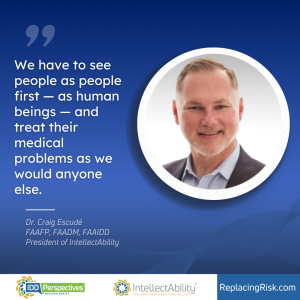
“We have to see people as people first — as human beings — and treat their medical problems as we would anyone else.”

This person-centered approach is at the heart of IntellectAbility’s mission: helping supporters and clinicians identify health risks that are often missed, and empowering them with the tools and training to replace risk with health and wellness. Recognizing each individual’s unique abilities and needs is essential to providing effective support. A comprehensive approach to care considers the whole person, not just their diagnosis, ensuring that support plans are tailored to the individual’s strengths and preferences.

Polypharmacy: When the “Fix” Becomes the Problem

Many times, a person’s distress or “behavioral” change is met with medication rather than investigation. Both physicians called out the alarming overuse of psychiatric and sedative drugs in the IDD population.

“We missed the thing causing the behavior, treated it with a medicine that has long-term side effects, ignored the side effects, and ten years later, we’re paying huge dollars for something that could have been prevented.” — Dr. Matt Holder

This cycle, prescribing medication to control behavior without identifying its root cause, can lead to polypharmacy, where multiple medications interact and compound side effects. Over time, the result can be over-sedation, movement disorders, aspiration pneumonia, and avoidable hospitalizations.

As Dr. Holder put it, “There’s so much preventable polypharmacy, so many preventable long-term side effects — and it really starts here, with the misinterpretation of behavior.”

Environmental and Social Triggers: When the Context Changes

Not every behavioral shift stems from a medical issue. Environment and social context often play equally important roles. A change in staffing, moving homes, a lost friendship, or even subtle shifts in daily structure can cause significant distress.

Dr. Holder highlighted the transition period between adolescence and adulthood as one of the most fragile times for people with IDD. When young adults “age out” of school systems and structured programs, the sudden loss of support networks can create instability, family burnout, and emotional distress. Community-based programs play a crucial role in providing ongoing assistance and support services, helping individuals remain connected and included within their community. Assistance from these community programs can help individuals navigate transitions and maintain stability during these challenging periods.

“It doesn’t always mean the person has to move out of the house,” he said, “but it does mean we have to help the family restructure their system of support before a crisis happens.”

Even sensory differences, like sensitivity to light, sound, or certain textures, can be powerful behavioral triggers. Dr. Escudé reminded attendees that “we’re all different,” and that both overstimulation and understimulation (boredom, lack of engagement) can cause frustration or attention-seeking behaviors.

Looking for Patterns: The Key to Understanding Behavior

Throughout the conversation, both presenters emphasized the importance of looking for patterns — what happens, when it happens, and what’s happening around it.

“It’s looking at the patterns and the context of behavior that can really help you figure things out.” — Dr. Craig Escudé

Consistent documentation of when behaviors occur and what precedes them can often reveal whether the cause is environmental, sensory, medical, or emotional in nature. Noting changes in adaptive behavior and cognitive functioning can also provide important clues to underlying issues, as shifts in these areas may indicate changes in intellectual or functional status. These patterns often serve as the missing link between confusion and understanding.

Misdiagnosis and the Cost of Overshadowing

Another common trap is diagnostic overshadowing, when behavioral or physical changes are automatically attributed to a person’s disability rather than a treatable condition.

Diagnosing mental health conditions and co-occurring conditions, such as autism spectrum disorder, in individuals with intellectual and developmental disabilities is particularly challenging. The onset and severity of symptoms can make accurate diagnosis difficult, especially when communication barriers exist. Recognizing mental health and neurodevelopmental issues requires careful assessment to avoid misattributing symptoms and to ensure appropriate support.

Dr. Holder cautioned that psychiatric diagnoses like depression, anxiety, or psychosis are often applied prematurely, particularly when communication barriers prevent accurate assessment. He described seeing people discharged from hospitals with diagnoses like ADHD or psychosis despite being nonverbal or medically complex.

“Once you have that diagnosis,” he said, “it explains everything else that goes wrong from now on. That’s something you don’t want to go lightly into.”

The result, he warned, is a “tail-wagging-the-dog” cycle: medications cause new side effects, which are misread as new behaviors, leading to even more medications.

Empowering Families, Direct Supporters, and Clinicians

The final portion of the webinar focused on solutions — specifically, what families and supporters can do when clinicians fail to listen or understand.

Dr. Holder’s advice was direct:

“If your doctor doesn’t listen to you, get a new doctor. Period.”

He explained that most physicians have received little to no training in IDD healthcare and that supporters often know far more about specific syndromes, conditions, or needs than the clinician does.

Dr. Escudé added that when doctors are willing to learn, families should seize the opportunity to collaborate and share resources. It is important to discuss care options with providers to ensure the best possible outcomes.

That’s one reason he wrote Clinical Pearls in IDD Healthcare: to provide families, nurses, and direct support professionals with a physician-written resource they can share with providers to encourage more accurate and compassionate care. Family support plays a critical role in advocating for individuals, coordinating care, and ensuring ongoing evaluation. The goal, he said, is simple: help clinicians “see what they’ve never been taught to see.”

Education, Prevention, and Person-Centered Practice

In closing, both doctors underscored that behaviors are forms of communication, not problems to suppress. Early identification and intervention during childhood are critical for supporting children with intellectual and developmental disabilities (IDD). Eligible children are entitled to special education and related services provided under the Individuals with Disabilities Education Act, which ensures access to appropriate support and inclusion. Through these services, individuals with IDD develop critical adaptive and cognitive skills, ultimately improving their lives throughout their development.

Whether the root cause is pain, frustration, sensory overload, or emotional loss, each behavioral change offers a chance to look closer — not medicate faster.

“Behavior is communication. When a person isn’t acting right, it’s not a problem to fix — it’s a message to understand.” — Dr. Craig Escudé

Key takeaway:

When people with IDD “don’t act right,” our first response shouldn’t be “What’s wrong with them?” but rather, “What are they trying to tell us?”

By slowing down, investigating, and listening — both medically and personally — we can prevent suffering, improve outcomes, and create systems that ultimately serve the people they are intended for.

Explore related resources:

For more resources, including practical guides and tips on effective healthcare spending in IDD, visit IntellectAbility’s website or explore the complete IDD Perspectives webinar series.